
Written by Jennifer Marie Finneran, Senior Agilist, Illumination Works
AI conversations often start with the same question: What can AI do? It’s an exciting question, with an exceptional number of possible answers. However, the question itself is too shallow to drive repeatable value. Enthusiasm for AI solutioning is a defining part of the current working experience.
Question the Workflow, Not the Technology
When considering the potential roles where AI could be of benefit, there are more thoughtful questions to ask first:
Where are workers experiencing friction in their current work? And what interventions can help reduce or remove that friction?
Consider how often some version of this pattern emerges during work:
Article Highlights
Information is missing or scattered across several places. The work needs to be documented, routed, assigned, or tracked. Someone must determine what happens next, move information between multiple systems, answer questions, and make decisions to keep the work moving.
None of this is unusual; in many organizations, it is simply how work gets done. Faced with all the tasks inside a seemingly simple request, we might ask how much work an AI agent could take on. But that innocent question presents a generally applied solution before truly examining and understanding the problem.
The goal of targeted workflow problem solving is not to find more places to use AI. The goal is to understand the work well enough to choose the right intervention by first understanding the cause of the friction within the current workflow. Finding the friction first ensures that the right problem is identified and analyzed, regardless of whether AI plays a role in the solution.
Start by Finding & Naming the Friction
Friction is the barrier between work that needs to be completed and the process, knowledge, understanding, coordination, or support available to complete it effectively. It is often treated simply as a problem to eliminate. A better approach is to treat friction as live, repeatable, diagnostic data about how the system of work is operating.
When delivery slows or work becomes difficult, organizations often begin by looking for a person or team that appears to be holding something up. Who has not yet responded to a time sensitive question? Who has the knowledge everyone else needs? Occasionally, an individual really can be the sole constraint on the productivity of a team. However, more often the constraint lies in the way that the work is being executed, rather than who is executing the work. Workflows can be complex, fragmented, inefficient, and time consuming. Often, capable people are required to gather large amounts of information across multiple tools or are reliant on the memories of others to obtain information about why a key decision was made.
There’s already immense pressure on technologists to mitigate risks and prevent bottlenecks. We often use AI to help, but wind up getting in our own way. With this Friction First evaluation and planning approach, ILW has really accelerated our project planning and execution. I’m thrilled that we can share it with others.
In many organizations, despite the best efforts of those managing and deploying necessary technical tools, there are humans who have shaped the flow of work to intentionally compensate for systems that can make executing the work harder than it needs to be.
The answer needed to resolve an outstanding issue may exist, but the defining details of that solution are often scattered across documents, dashboards, software products, or the memories of individuals. Someone may spend hours sorting requests that follow predictable patterns. A process may create traceability while demanding too much administrative maintenance. Naming the friction correctly matters and it is possible for more than one type of friction to exist in a defined workflow. Each type of friction points to a different problem in the flow of work, and must be examined.
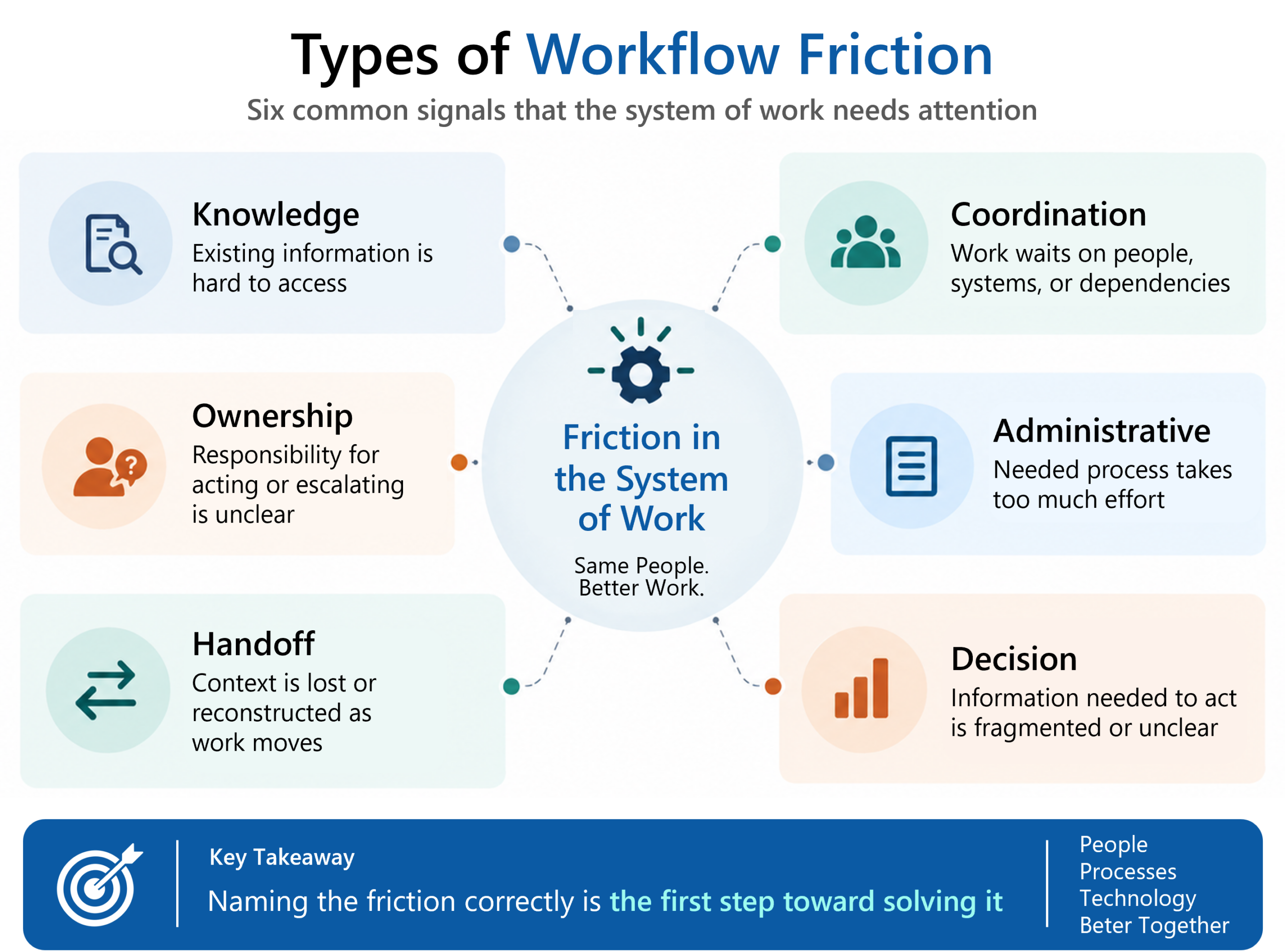
It is important to note that not every point of friction should be removed. Repeated data entry and avoidable waits consume time without improving the result. A deliberate review or decision gate may take time precisely because it protects quality, safety, or accountability. The IBM Institute for Business Value’s 2026 CEO Study makes a related point: speed can result from productive friction rather than from eliminating every pause [1]. The goal is to distinguish effort that adds value from effort that simply makes work harder.
Before introducing AI, ask what a slow step costs and what purpose it serves. Would removing it create a better outcome, or would it remove a useful check? The answers show whether the step should be eliminated, simplified, redesigned, preserved, or supported by a different intervention.
Fix the Workflow, Not Just a Single Step Within It
AI can summarize meetings, draft documents, review tickets, or respond to requests, but looking only at individual tasks is a dangerously narrow view of an activity. Each activity sits within a larger workflow, but if one activity is accelerated without understanding the whole process, the organization may simply move the friction to a different point within the same workflow, without any meaningful gains. An AI tool might turn thirty minutes of research and drafting into a five-minute first pass. A person may still need to check the sources, correct errors, approve the result, and keep the new file current. This workflow change has now moved the bulk of the effort from generation to validating and maintaining the documentation. The first step in the modified workflow is now faster, but the request may take nearly as long to complete as it would have if AI had not been a part of the workflow. This result is a prime example of moving friction, rather than solving it.
Microsoft Research found a related pattern in a randomized experiment involving 6,000 knowledge workers: generative AI substantially reduced individuals’ time spent on email, while meeting time did not significantly decline [2]. Reducing friction across the whole workflow may require the team to change how it prepares decisions, shares information, and hands work off. Faster individual output alone may not ultimately have any impact on the final result.
Once the surrounding workflow is visible, the next question is not whether AI can perform the activity. It is which intervention can solve the actual source of friction reliably and with the least unnecessary complexity. So, choose the lightest reliable intervention. The best intervention is the simplest one that reliably solves the problem. A more complex AI solution does not make that solution more advanced or more valuable. OpenAI’s guidance for building agents makes a similar distinction, recommending agents when workflows involve complex or context-sensitive decisions, rules that are difficult to maintain, or substantial unstructured information, while noting that deterministic approaches may be sufficient when those conditions do not exist [3].
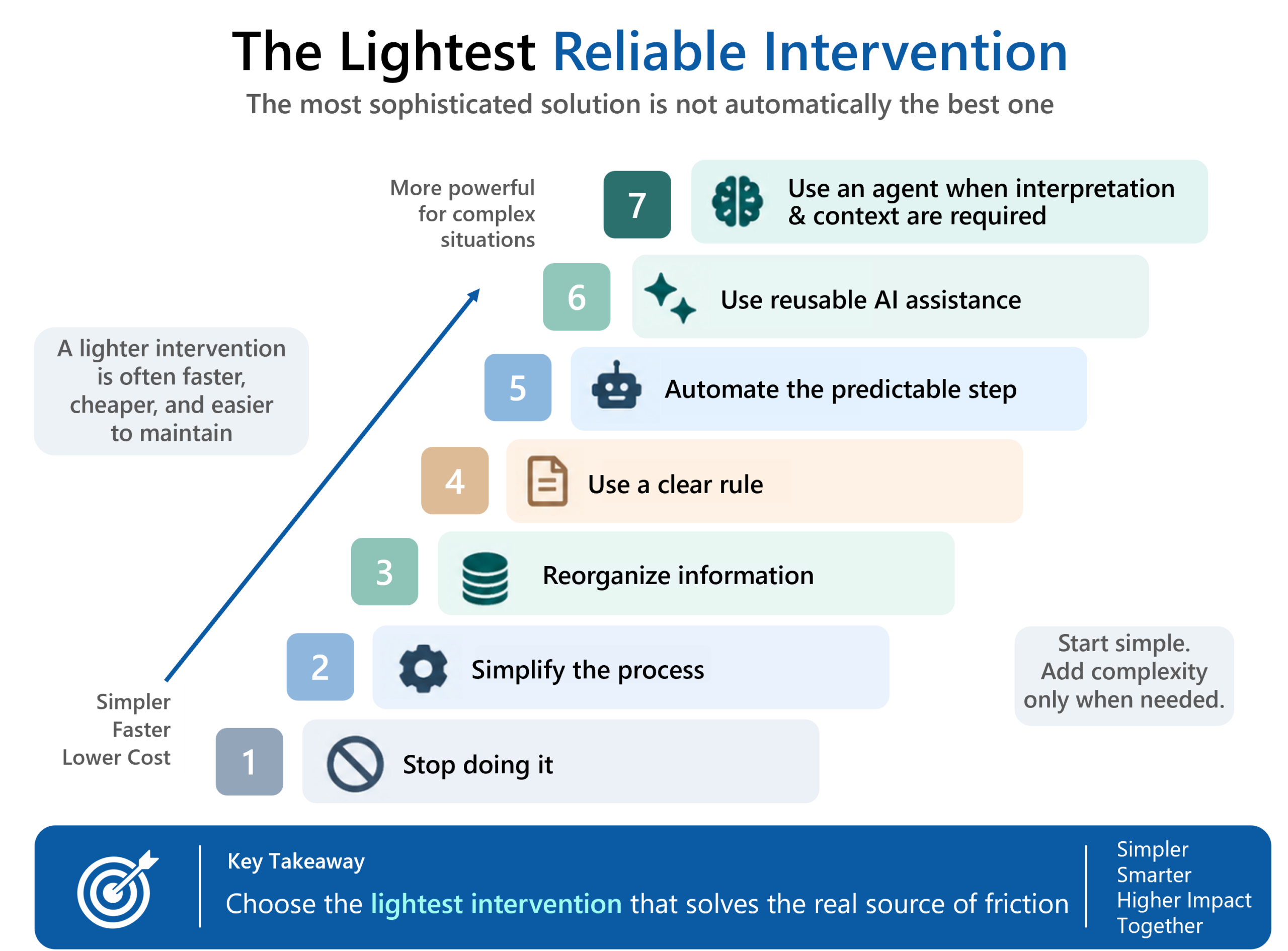
When friction within a workflow has been identified, the next step is examining which available solution is best suited to supporting the work. When making that decision, it’s important to identify the possible options, the risks and strengths of each option, and the human cost associated with each solution.
Rule-based automations: When requests follow a known format, automations might provide the best leverage. For example, Power Automate or Jira automations can create records, route work, and send reminders. The human in the loop becomes responsible for determining the rules, testing the automation, and handling any exceptions.
One-off prompts: If a specific task or request needs a clearer summary, AI can help synthesize information and make it easier to understand quickly. A human must supply the relevant context, use AI to draft the summary, and verify the output.
Reusable AI skills: When summaries follow a repeatable pattern, an AI skill can be written with specific instructions to help identify and handle work that follows that pattern. The skill can then follow those instructions, help generate a template, and suggest quality checks. However, even here the human-in-the-loop is responsible for keeping the skill updated as the flow of work changes, validating the output, and ensuring that it reaches the intended audience.
Agent: When a request calls for several context-sensitive steps across sources, an agent can gather context, flag conflicts, and propose a route or ticket based on the context provided. The results produced by an agent can be extensive and valuable. But a human must read and digest the output, confirm its meaning, approve any consequential updates or changes based on it, and ultimately take responsibility for the outcome.
Choosing among the different levels of automation, AI involvement, or improvements led by people requires human judgment. Human judgment must have a role in determining the right intervention for the work at hand. If AI is the right intervention, proceed with the risks in mind. If automation is best, ensure that automation outcome is worth the time invested creating and validating the automation. If simplifying the process or reorganizing the information is the best next step, then ensure that the manual work reflects how the team really works before restructuring the process. There is a balance to be achieved between AI and human effort. When that balance is carefully considered prior to acting, the outcome is more likely to be positive for everyone involved.
Friction is the signal. AI is the accelerator. Human ingenuity is the differentiator. Treat friction as diagnostic intelligence to rethink and optimize entire workflows—not just automate inefficiencies. Let AI handle the burdensome work so humans can focus on what matters most: critical thinking, proactive problem-solving, collaboration, and innovation. The goal isn’t maximum automation—it’s maximizing impact by combining AI’s efficiency and scale with human ingenuity, judgment, and accountability.
If AI Belongs in the Workflow, Thoughtfully Design AI’s Boundaries
Once AI participates in the workflow, the design problem changes. It is no longer enough to say that a human will be “in the loop.” The organization needs to decide what the system knows, what it may do, who owns the outcome, and what happens when it cannot proceed safely. NIST’s AI Risk Management Framework similarly emphasizes clear human and AI roles, responsibilities, governance, and ongoing risk management [4].
What does the system know? Authoritative system state, supporting evidence, inference, recommendation, and action are not the same kinds of information. A likely dependency may justify asking someone to confirm it, but it may not justify changing the system of record. The source of the evidence, its reliability, the consequence of being wrong, and the owner of the decision should influence what the system is allowed to do.
What is the system allowed to do? Technical capability is not the same thing as permission. A system may be allowed to read, summarize, classify, recommend, or prepare an action while being prohibited from changing a system of record. Autonomy should be earned through evidence rather than granted through enthusiasm.
Who owns the outcome? If AI recommends an action, who owns the decision? Who updates the instructions when the process changes? Every AI-enabled workflow creates an ownership model whether the organization deliberately designs one or not. Ownership is part of the architecture, not administrative overhead surrounding it.
What happens when the system cannot proceed safely? Reliable workflows need explicit escalation points, validation criteria, and routes back to human judgment. Missing information, conflicting sources, or high-risk actions should not be discovered only after something fails. NIST’s Generative AI Profile treats testing, monitoring, incident review, and defined organizational responsibility as lifecycle activities rather than one-time deployment tasks [5].
Good design removes unnecessary human middleware while protecting the places where human participation materially improves the result. A person repeatedly copying information between systems or reconstructing known context is not necessarily exercising valuable human judgment. People are extremely valuable when work requires application of contextual judgment, strategic trade-offs, relationship building, creativity, stakeholder trust, negotiation, and accountability. That unique value deserves thoughtful design and consideration.
Measure the Friction Removed, Then Scale What Works
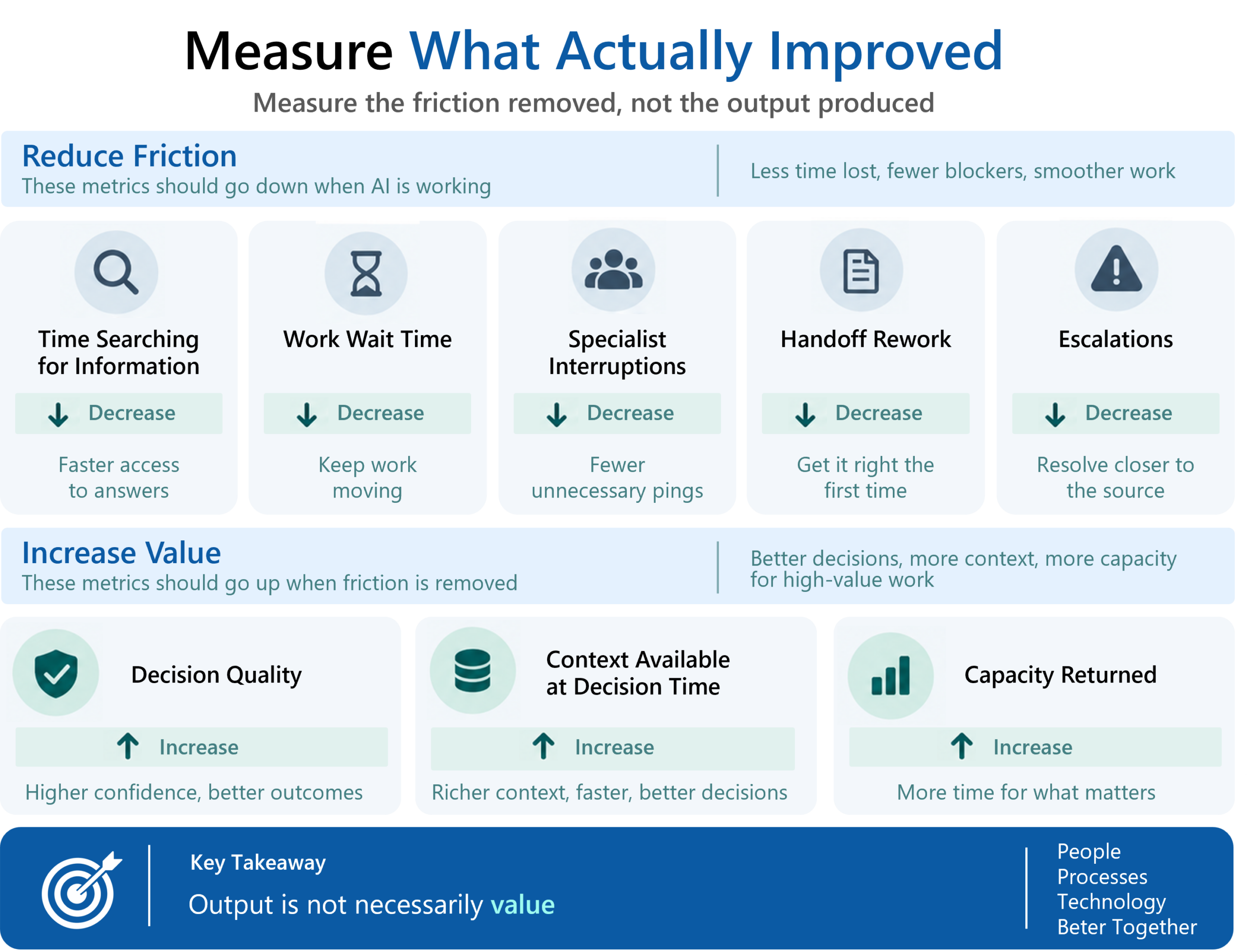
AI output is not the same as business value. The number of prompts, summaries, agents, automated actions, or generated documents tells us little about whether the organization functions more efficiently. If friction justified the intervention, friction should anchor the measurement. This can be tested by gathering and analyzing metrics like: Did people spend less time searching for information? Did quality improve? Did the organization recover capacity previously consumed by administrative work?
Returning human capacity is one of the most sought-after outcomes of reducing friction. However, returned capacity is only as valuable as what that capacity can be applied to next. Recovered capacity does not automatically become organizational value. It can support deeper problem solving, quality, customer relationships, learning, mentoring, innovation, collaboration, or additional delivery where increased throughput genuinely creates value. The choice should be explicit when determining if value has truly been returned.
Successful local experiments also create a scaling decision. If every team independently develops its own prompts, agents, and governance rules for the same class of problems, one form of friction has simply been replaced by another. The answer is not to centralize every experiment before people are allowed to learn. A better pattern is to prototype locally, validate the value, identify the reusable pattern, package what works, and scale deliberately so that reusable content and patterns can become organizational assets. A small, localized change may solve a local problem. A mature solution helps the organization learn how to solve that class of problem repeatedly.
Final Thoughts
AI-enabled workflows combine models, data, and interfaces with people, roles, decision rights, and practices. Research applying sociotechnical systems thinking to AI makes the same point: organizational outcomes emerge from the interaction of the social and technical parts of the system, not from either one in isolation [6]. This highlights the intersection of people, processes, and data, which previously have often been considered distinctly separate areas. Data Science contributes model and evaluation expertise. Engineering provides integration and platform foundations. Business Agility contributes a systems-of-work lens to AI transformation by examining flow, constraints, feedback, experimentation, and facilitating adoption. No single discipline owns the problem of AI-enabled workflows. The value comes from combining disciplines together to ensure that friction is correctly identified, addressed, measured, and improved across organizations.
The objective is not to advocate for AI everywhere, nor to preserve every existing activity because that is how work has historically been done. It is to understand the system well enough to choose the right intervention, define the right boundaries, and improve the work as a whole.
Technology will continue to change. The discipline of understanding work should not. Organizations that learn to identify friction, choose the lightest reliable intervention, preserve meaningful human judgment, and measure what truly improves will be better positioned to turn AI investment into lasting operational value.
References
- IBM Institute for Business Value. (2026). Rewiring the C-suite: The fast track to 2030. 2026 CEO Study. IBM 2026 CEO Study
- Dillon, E., Jaffe, S., Immorlica, N., & Stanton, C. (2025). Shifting Work Patterns with Generative AI. Microsoft Research. Microsoft Research: Shifting Work Patterns with Generative AI
- OpenAI. A Practical Guide to Building Agents. OpenAI: A Practical Guide to Building Agents
- National Institute of Standards and Technology. (2023). Artificial Intelligence Risk Management Framework (AI RMF 1.0). NIST AI 100-1. NIST AI Risk Management Framework
- National Institute of Standards and Technology. (2024). Artificial Intelligence Risk Management Framework: Generative Artificial Intelligence Profile. NIST AI 600-1. NIST Generative AI Profile
- Makarius, E. E., Mukherjee, D., Fox, J. D., & Fox, A. K. (2020). Rising with the machines: A sociotechnical framework for bringing artificial intelligence into the organization. Journal of Business Research, 120, 262-273. Journal of Business Research article
About the Author
Jennifer Finneran is a Senior Consultant at Illumination Works with over 15+ years of experience spanning software development, business analysis, product ownership, Agile delivery, and enterprise systems. Her work focuses on the intersection of people, processes, and technology, with an emphasis on identifying operational friction and designing practical, human-centered solutions. She combines systems thinking, business agility, and applied AI to improve how teams work, reduce administrative burden, and create sustainable organizational improvements. Jennifer is particularly interested in how organizations can adopt AI responsibly, preserving human judgment while using technology to make work simpler, more effective, and more meaningful.

Learn More
If you liked this article, you may also like:
- Uncertainty Estimation in AI
- Uncertainty in AI Domains
- Psychology of Decision-Driven BI/BA
- Navigating the Maze of AI Cyber Risks
Special thanks to the technical reviewers and contributors for this article:
- John Tribble, Director of Data Science
- Janette Steets, Associate Vice President, Defense Division
- Meredith Zang, Data Scientist
- Erica Swanson, Data Scientist
About Illumination Works
Illumination Works is a trusted technology partner in user-centric digital transformation, delivering impactful business results to clients through a wide range of services including big data information frameworks, data science, data visualization, and application/cloud development, all while focusing the approach on the end-user perspective. Established in 2006, the Illumination Works headquarters is in Beavercreek, Ohio. In 2020, Illumination Works adopted a hybrid work model and currently has employees in 25+ states and is actively recruiting.
Check out the our Newsroom for more company highlights!